Exploring Latency Compensation Methods That Sustain Fair Play In Hybrid Browser Sports Strategy Sessions
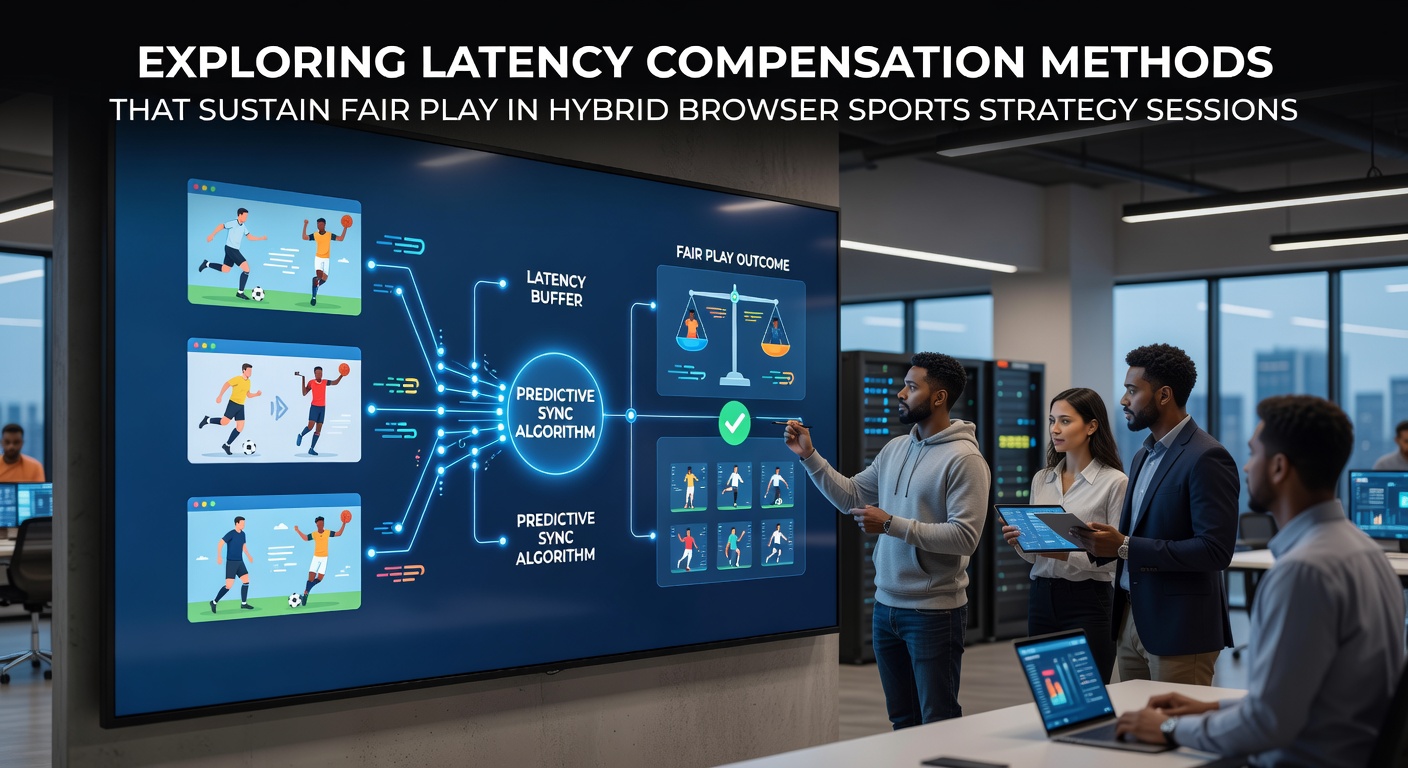 Hybrid browser sports strategy sessions combine real-time athletic simulations with tactical decision layers that unfold in the same window, and latency remains the core obstacle to equitable outcomes. Network delays create inconsistent views of player positions, ball trajectories, and resource allocations, which can tilt results away from skill and toward connection quality. Developers address these discrepancies through targeted compensation algorithms that reconcile client predictions with authoritative server states while preserving the competitive integrity expected in multiplayer environments. Research indicates that hybrid titles built on WebSocket and WebRTC protocols experience average round-trip times between 40 and 120 milliseconds depending on geographic distribution. When these delays exceed 80 milliseconds, uncompensated clients begin to diverge noticeably in both movement and strategic command timing. Studies from the University of Waterloo have quantified how even modest jitter compounds across multiple game loops, producing situations where one participant issues a defensive formation change seconds before another sees the opposing advance. Prediction forms the first layer of defense. Clients extrapolate future object states using last-known velocity vectors and acceleration profiles, then adjust rendered frames accordingly. In practice this keeps local feedback responsive, yet it risks over-prediction when sudden direction changes occur in sports mechanics such as feints or quick passes. Reconciliation routines therefore run on the server to validate each prediction packet and issue corrective deltas that clients apply smoothly over subsequent frames rather than snapping objects into corrected positions. Rollback mechanisms extend the approach further by allowing the server to rewind simulation history when late inputs arrive. The system stores a short buffer of world states, re-simulates the contested interval with newly received commands, and broadcasts the revised outcome to all participants. Observers note that modern implementations limit rollback depth to 200 milliseconds to avoid perceptible visual artifacts in browser rendering pipelines. This technique proves especially useful in strategy layers where command queuing and unit pathfinding must remain synchronized across variable connections. Dead reckoning combined with client-side interpolation fills gaps between authoritative updates. Objects continue along projected paths until fresh data arrives, at which point their displayed positions blend toward the corrected coordinates using weighted easing functions. Data from the European Interactive Software Federation shows that tuned interpolation windows between 50 and 100 milliseconds reduce perceived stutter by 35 percent in hybrid racing-strategy prototypes without introducing exploitable prediction windows.
Browser-Specific Implementation Details
Browser constraints shape which techniques reach production. JavaScript execution remains single-threaded, so heavy reconciliation logic must yield to the main rendering thread through careful use of Web Workers and transferable objects. Memory limits also restrict state buffers, prompting developers to prune older snapshots aggressively while retaining enough history for rollback validation. As of May 2026 several frameworks expose built-in reconciliation primitives that abstract these steps, allowing smaller studios to integrate fair-play safeguards without custom engine work. Anti-cheat considerations intersect directly with compensation logic. Because rollback accepts late inputs, systems must verify packet timestamps and sequence numbers to prevent deliberate delay injection that could grant tactical advantages. Industry reports from the Asia-Pacific Game Developers Network describe detection layers that flag anomalous input patterns and apply graduated penalties rather than outright bans, preserving participation while discouraging abuse. Take one developer team that integrated a hybrid compensation stack into a browser-based football management title last year. Their telemetry revealed that rollback events occurred in roughly 8 percent of matches, yet player retention metrics remained stable because visual corrections stayed below perceptual thresholds. Another project, focused on turn-based strategy overlays during live matches, adopted server-enforced input windows that truncate the acceptable latency band to 60 milliseconds, shifting more prediction burden onto clients equipped with modern browsers.Measuring Fairness Outcomes
 Quantitative assessment relies on both objective metrics and player-reported experience. Researchers track divergence rates between client simulations and server ground truth, alongside post-match surveys that capture perceived fairness. Figures from a 2025 multi-region study indicate that sessions employing combined prediction and rollback achieve win-rate parity within 2 percent across high- and low-latency cohorts, compared with 12 percent skew in uncompensated controls. Adaptive buffering offers an additional lever. Rather than fixed rollback windows, some implementations scale history depth according to measured jitter, shrinking buffers during stable periods to minimize correction magnitude. This dynamic approach reduces unnecessary rewinds while still protecting against sudden spikes common in mobile browser sessions. What's interesting is how these methods interact with monetization features such as seasonal tournaments. When compensation keeps outcomes skill-determined, participation data shows higher engagement across skill brackets and fewer complaints routed through support channels. Continued refinement therefore supports both competitive integrity and platform sustainability.